
The ABCD Building and Dholera’s Operational Identity
One of the most visible signs of Dholera’s maturity is the ABCD Building, the Administrative and Business Centre of Dholera. Officially, it includes the Business & Exhibition Center (BEC) and the SPV Building. It houses offices, conference and event facilities, and the City Integrated Operations Centre (CIOC), which monitors traffic, surveillance, utilities, emergency response, and e-governance systems in the Activation Area.
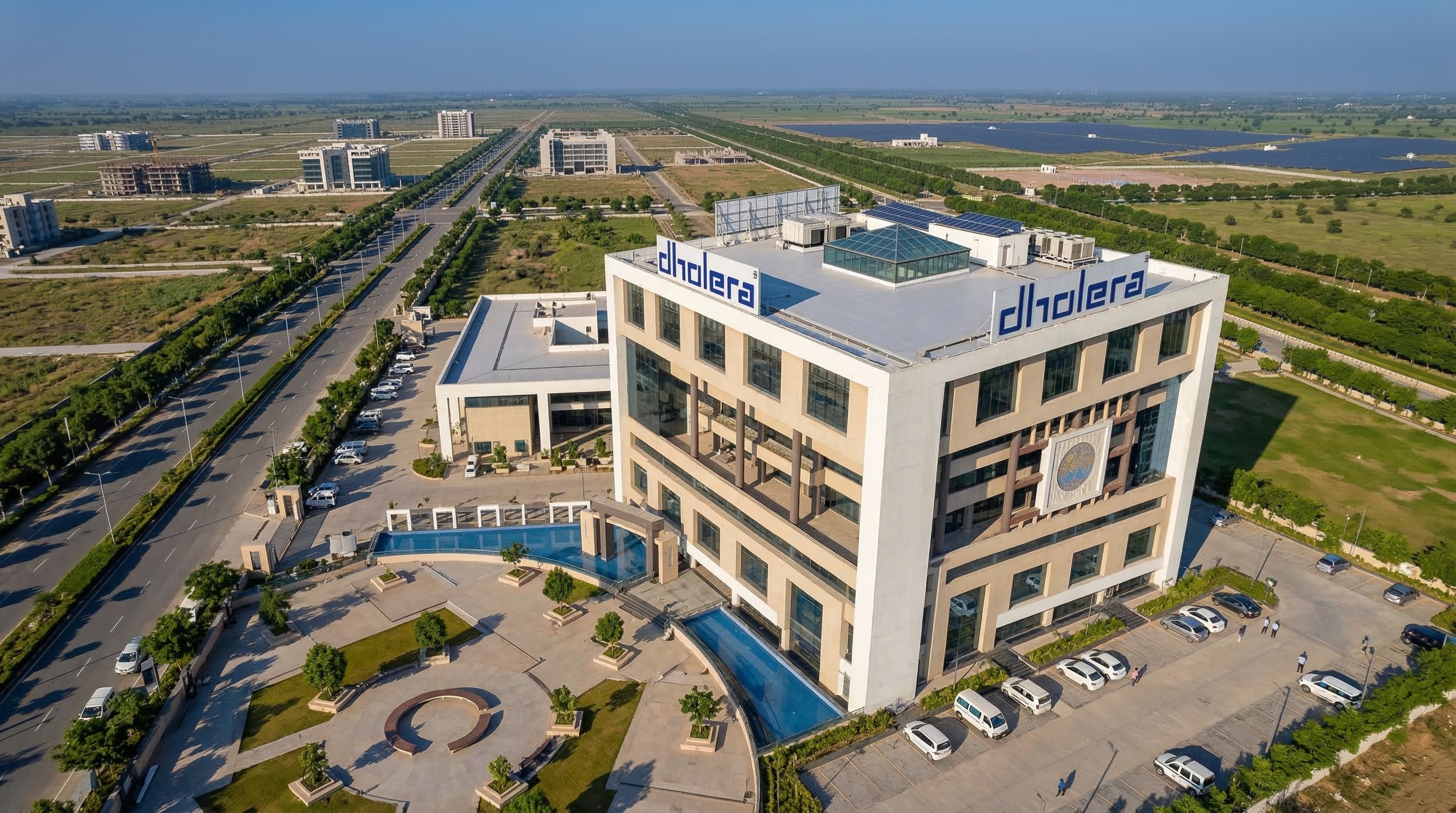
Every major planned city eventually reaches a symbolic moment when it stops looking like a project site and starts looking like an operating place. In Dholera’s case, one of the clearest symbols of that shift is the ABCD Building — the Administrative and Business Centre of Dholera. More than just a landmark structure, it represents the emergence of Dholera’s operational identity.
The official Dholera portal identifies the ABCD Building as part of the Dholera office ecosystem and places it on the Dholera–Dhandhuka Highway. The site also explains that the ABCD complex includes two principal components: the Business & Exhibition Center (BEC) and the SPV Building. This composition is revealing. It means the complex is not just an office block for administrators; it combines governance, business interface, and public-facing functionality.
The functions housed in the ABCD Building underline its importance. Official descriptions note that it includes administrative offices, conference rooms, an auditorium, banquet and restaurant facilities, a bank, a post office, and an experience zone. These features show that the building was designed as a civic-business anchor for the first phase of the city. In infrastructure-led developments, such buildings matter because they create a visible center of gravity for officials, investors, visitors, consultants, and potential allottees. They also help project seriousness and administrative permanence.
Perhaps the most consequential feature within the ABCD Building is the City Integrated Operations Centre (CIOC). The official home page references the CIOC at Dholera Special Investment Region, and descriptions of the center indicate that it is intended to monitor and manage city functions such as traffic, surveillance, utilities, emergency response, and elements of e-governance. This is highly significant in the history of Dholera because it reflects the smart-city premise in operational form. Instead of presenting “smart” as a branding term, Dholera built a control and monitoring center into its administrative core.
Historically, the ABCD Building signals a deeper transition in Dholera’s journey. Earlier stages were about legal framework, regional planning, institutional creation, and infrastructure execution. The ABCD phase is about visible administration, integrated operations, and city identity. It creates a place where the project can be experienced, governed, demonstrated, and coordinated. In many ways, this is the moment Dholera begins to resemble an emerging city-platform rather than a dispersed infrastructure project.
The ABCD Building therefore occupies an outsized place in Dholera’s story. It is both a practical asset and a symbolic milestone. Practically, it centralizes administration and smart-city operations. Symbolically, it tells investors and observers that Dholera has progressed from planning documents and civil works toward institutional presence and live management. In the chronology of Dholera so far, that makes it one of the most prominent markers of maturity.