
The Legislative Foundation of Dholera
Dholera’s journey began with a policy decision to create a large-scale, future-oriented industrial and urban region in Gujarat. The legal basis was the Gujarat Special Investment Region Act, 2009, which established the framework for declaring, planning, governing, and developing Special Investment Regions in the state.
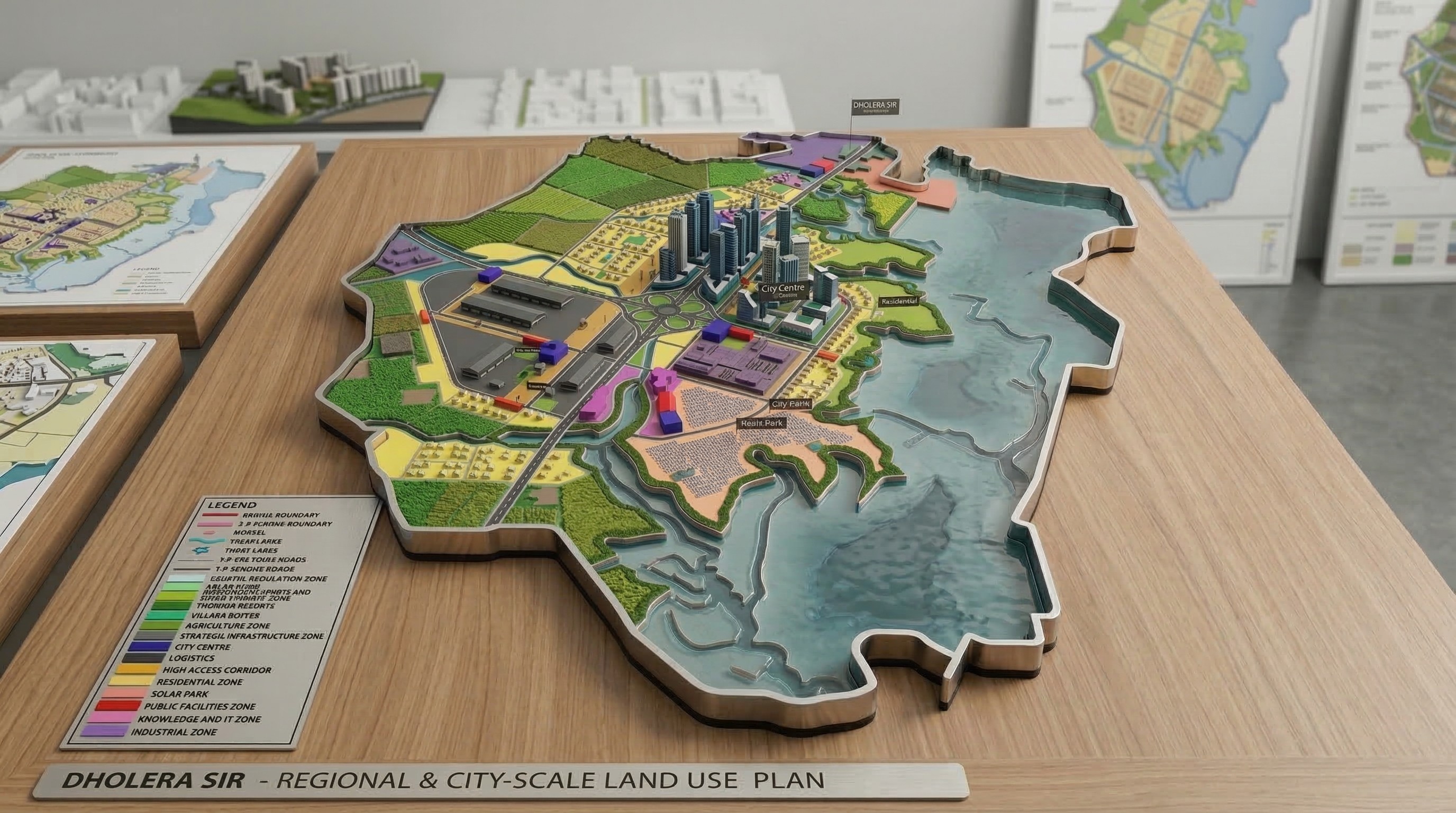
Dholera’s journey began with a policy decision to create a large-scale, future-oriented industrial and urban region in Gujarat. The legal basis was the Gujarat Special Investment Region Act, 2009, which established the framework for declaring, planning, governing, and developing Special Investment Regions in the state. Dholera was then taken up as the flagship SIR under this framework. The law enabled the creation of dedicated authorities, planned infrastructure, phased development, and a governance model meant to support industrialization, urban growth, and large-scale investment.
The story of Dholera SIR formally starts in the late 2000s, when Gujarat began building a statutory model for very large industrial and urban investment zones. A major early milestone came in May 2008, when Dholera was approved as a node under the Delhi-Mumbai Industrial Corridor (DMIC), linking it to one of India’s most important industrial infrastructure visions. This was significant because it placed Dholera within a national-scale growth corridor, rather than leaving it as an isolated state-led real estate or industrial development concept.
The next decisive milestone came with the enactment of the Gujarat Special Investment Region Act, 2009. According to the official Dholera portal, this law came into effect on 6 January 2009. Its purpose was to provide Gujarat with a dedicated legal architecture for establishing and governing Special Investment Regions. The Act empowered the State Government to declare Investment Regions and Industrial Areas and designate them as SIRs. It also set threshold scales, stating that an Investment Region would have an area of more than 100 square kilometres, while an Industrial Area would have an area of more than 50 square kilometres.
The salient features of the law are central to understanding why Dholera developed differently from a standard township or industrial park. First, the Act created a clear governance framework, which is critical in projects of this scale. Second, it enabled planned infrastructure development, allowing the state to think in terms of roads, utility corridors, zoning, and city systems instead of fragmented plot-by-plot growth. Third, it aimed at faster approvals and more structured industrial promotion, which made the law more than a planning statute; it became an investment-enabling instrument. The official description of the Act emphasizes industrial development, high-value investments, large employment zones, and sustainable urban growth.
In practical terms, the law created the conditions for a region like Dholera to be conceptualized as an integrated economic territory. That meant the state could legally move beyond traditional municipal expansion and instead design a hybrid industrial-urban zone with dedicated institutions and planning controls. This is one of the reasons Dholera is often described as a smart industrial city rather than simply a city extension.
Historically, this stage matters because every later milestone in Dholera’s story rests on this statutory base. Without the 2009 Act, there would be no legal mechanism for the dedicated authority, the planning schemes, the SPV-led infrastructure model, or the phased activation-area strategy that followed. In that sense, the legislative phase was not just administrative groundwork. It was the moment the Dholera vision became actionable under law.